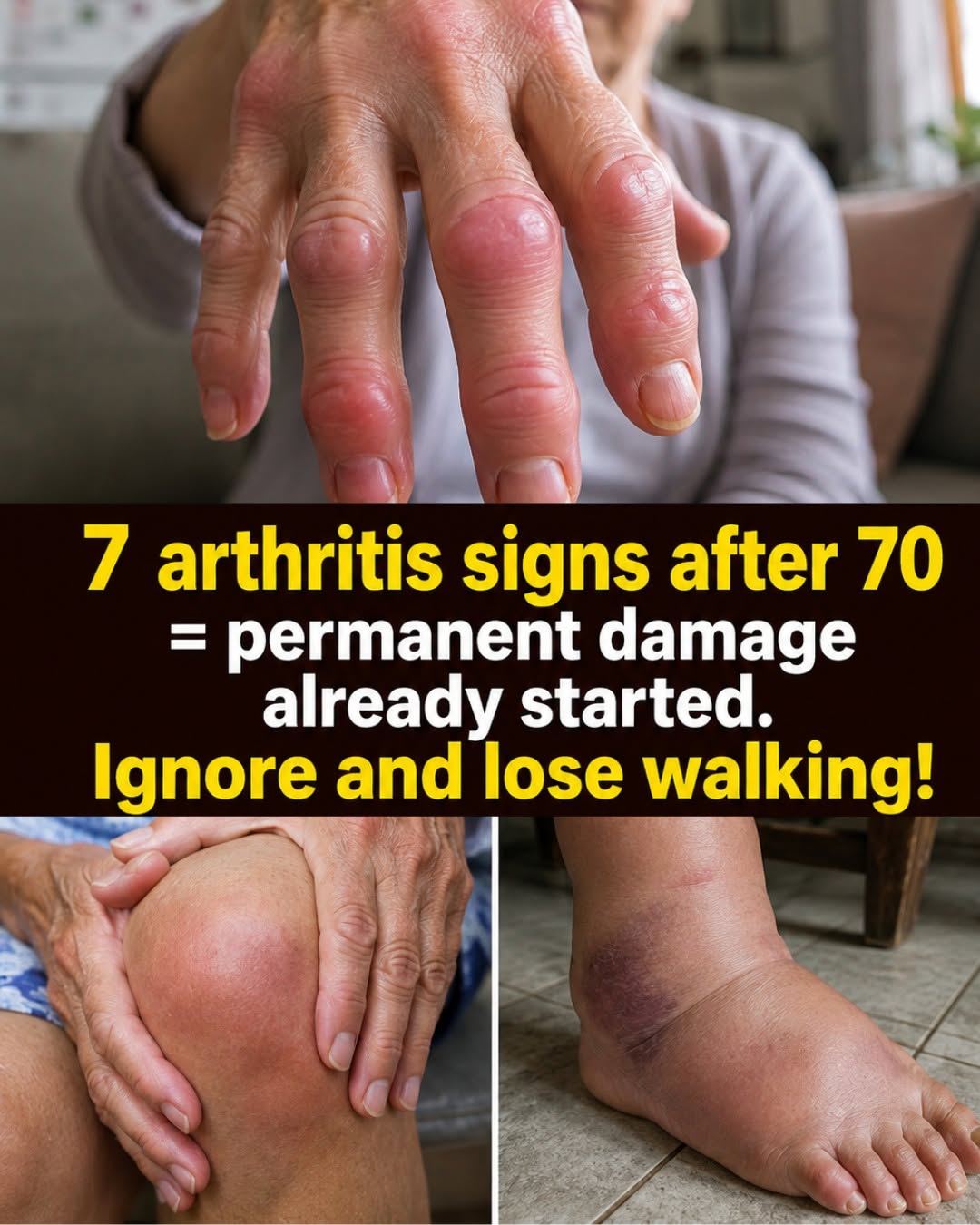
Your fingers don’t just “get older.” They swell, stiffen, and start sending sharp little warnings every time you grip a mug, twist a jar, or push yourself out of a chair. In the Facebook post, the threat is blunt: 7 arthritis signs after 70 can mean permanent damage has already started, and ignoring them can cost you walking. That’s not a random scare line. It points straight at the joints, the hands, the knees, the ankles, and the feet — the places where arthritis turns ordinary movement into a daily negotiation with pain. By evening, the rings feel tighter. In the morning, the knuckles look puffy and angry, like they spent the night trapped in a vise. And once the pain starts marching from one joint to the next, it doesn’t feel like “aging” anymore — it feels like your body is quietly locking doors behind you. The problem is that most people blame the years instead of the machinery underneath. Cartilage wears down, inflammation flares, fluid gathers where it shouldn’t, and the joint becomes a rusted hinge that groans every time you ask it to move. The body doesn’t suddenly betray you. It sends a pattern of small alarms first. The first alarm is the stiffness that steals your morning When arthritis starts tightening its grip, the first thing people notice is the dead, wooden feeling in the joints after rest. Hands won’t open fast. Knees feel like they’ve been packed with wet cement overnight. Think of a door hinge left outside in salt air for years. It still moves, but every swing takes more force, and every swing grinds a little metal away. That’s what inflamed joints do from the inside — they turn simple motion into friction. Then comes the second warning: swelling that makes the joint look and feel swollen, hot, and angry. That puffiness is not decoration. It’s the body flooding the area with inflammatory fluid, and that pressure starts crowding out comfortable movement. BuyingEducational Human Anatomy Models So you sit at the breakfast table, staring at a spoon, already negotiating with your own hands before the day has even begun. That tiny battle repeats until it feels normal — and that’s exactly how damage keeps advancing unnoticed. Why the knees and feet often scream first The knees carry the load of every step, every stair, every awkward turn in the kitchen. When arthritis digs in there, the joint stops acting like a shock absorber and starts acting like a cracked wheel bearing. One wrong pivot by the sofa and you feel it: a stab, a catch, a deep ache that lingers. Later, the stairs become a calculation. By the time you reach the top, the joint feels thick, heavy, and unreliable. The feet tell their own story. A swollen ankle, a burning ball of the foot, toes that don’t want to bend — those are not “little annoyances.” They are the foundation of walking getting sabotaged from below. When the foundation shifts, the whole house starts to lean. That’s why people begin to shorten their stride without noticing, then avoid walks, then avoid errands, then avoid anything that asks too much of the joints. Why hands reveal the damage before anyone else sees it Hands are the loudest tattletales in arthritis. Knuckles thicken, grip weakens, jars become enemies, and buttons turn into tiny acts of war. It’s like trying to run a machine with gears packed in sticky sludge. The gears are still there, but they no longer mesh cleanly, so every task takes more effort and leaves more strain behind. Here’s the part most people miss: the body is not asking for perfection. It’s asking for less pressure, less internal fire, and better raw biological fuel so the joints stop living like a machine running dry. BuyingEducational Human Anatomy Models When that shift starts, people notice the small victories first — a hand that opens easier, a knee that complains less on stairs, a morning that doesn’t begin with a wrestling match against the sheets. P.S. One common habit wrecks the whole process: people keep protecting the sore joints so aggressively that the surrounding muscles weaken, and the joint gets even less support. That creates a vicious loop — less movement, more stiffness, more fear, and faster decline. The next piece is the one that changes the game: a simple pairing that helps the body handle the pressure without turning every step into a battle. This article is for informational purposes only and does not replace professional medical advice. Please consult your healthcare provider for personalized guidance.
7 Arthritis Signs After 70 That Signal Joint Damage Is Already Spreading